
The Accelerating Clock:
Tracing the Neural
Mechanisms of Age-Related
Time Perception
Reading Time: 6 Minutes
Date Published: 4/24/2026
Author: Elias Mekuriaw
Artist: Elgin Tawiah
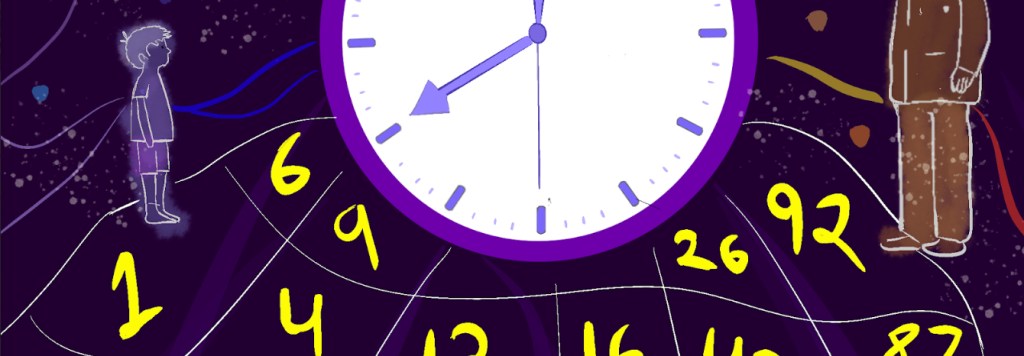
In 1877, the French philosopher Paul Janet proposed a mathematical model for a sensation that had plagued humans for centuries: that puzzling and all-too-familiar feeling that time moves faster as we age. Janet suggested a proportional theory, arguing that human time perception is relative to the total duration of our lived experience. To a five-year-old, one year represents 20% of their entire life, a massive, seemingly endless epoch. However, to a fifty-year-old, that same year constitutes only 2% of their life, passing by with a comparative transience.1 While this seemingly obvious explanation offers a logical framework, modern neuroscience reveals that this phenomenon reflects tangible physiological shifts within the aging brain.2
To understand this shift, scientists distinguish between prospective timing (i.e., judging time as it passes) and retrospective timing (i.e., judging time looking back). Curious to see if our sense of time changes with age, psychologist Peter Mangan3 experimented on adults of different ages. Mangan asked young adults (early 20s), middle-aged adults (40s), and older adults (60+) to estimate when a three-minute interval had elapsed. The young adults were remarkably accurate, estimating within three seconds; the older adults, however, consistently overshot the mark by about forty seconds. Middle-aged adults fell between older and younger adults, but, similar to older adults, they also underestimated the actual elapsed time. This indicates that their internal clock was innately ticking more slowly than the typical analog clock; as a result, the external world appeared to move faster relative to their internal state. This initially felt astonishing because it implied that the sensation of time accelerating was not merely a psychological illusion of looking back over decades, but instead a measurable biological discrepancy occurring in intervals as short as a few minutes.
If timing errors occur within a span of a few minutes, the next question becomes: what changes in the brain would spark this? Among the network of structures involved, neuroscientists have traced this sense of time to the basal ganglia, a cluster of nuclei that track time among other roles, and the substantia nigra, a small region in the midbrain that produces dopamine. Together, these structures maintain the brain’s internal clock.4 In this neural context, the internal clock is not a mechanical ticker, but a network of cortical neurons firing in rhythmic loops, known as oscillations. Signals originating from the substantia nigra generate these oscillations; meanwhile, the basal ganglia monitor and register these oscillatory patterns to measure duration. Dopamine helps set the pace of the system, determining the rate and reliability of these oscillations. However, as we age, these dopaminergic pathways begin to deteriorate:5 dopamine signals weaken, resulting in sluggish and erratic firing potentials.6 As a result, fewer signals are generated and counted within a given time interval; the brain, therefore, concludes that less time has passed than in actuality. The result is a subtle illusion: the internal clock slows down, while the outside world seems to move faster and faster.
Alongside the slowing of the biological pacemaker, aging may also affect how the brain allocates attention to time. To explain this, Zakay and Block7 proposed the Attentional Gate Model, a framework that envisions an internal pacemaker that generates pulses that pass through an attentional gate and are counted by an accumulator. The number of pulses that reach the accumulator determines the perceived duration. More importantly, the gate is regulated by attention: the more an individual focuses on the passage of time, the wider the gate opens, allowing more neural ticks to be counted. However, when attention is diverted to a difficult task, the gate narrows, allowing fewer pulses to pass through and leading to shorter perceived durations.7
It is important to note that as we age, the many age-related differences in time perception surface not only from internal changes but also from changes in cognitive resources, such as attention and working memory.1 One possible explanation may stem from older adults often devoting more attention to the activity at hand rather than monitoring time, which potentially distorts perceived duration.8 Consequently, the gate remains closed more frequently, causing significant stretches of time to pass uncounted and unregistered, a phenomenon that leaves the individual feeling as though the day has evaporated.
In addition, time perception may be shaped by several other factors, including level of arousal, mood, certain clinical conditions, and use of psychoactive drugs (e.g., dopamine agonists).1 Since these influences vary widely across individuals, experiences of duration may also vary across different populations.
However, the feeling that years are slipping by depends as much on how our brain encodes memories as it does on dopamine levels. Neuroscientist David Eagleman9 has explored how the brain encodes new experiences versus routine ones. For a young child, a summer day is filled with novel sights, sounds, and sensations; the brain works vigorously to process this new information, activating previously dormant neural pathways and creating dense, richly detailed memories. Robert Ornstein10 builds on this with his storage size hypothesis, which suggests the more complex and information-rich a period is, the longer it is perceived in retrospect.
In contrast, adult life often unfolds in predictable routines. The brain, an energy-efficient organ, employs neural adaptation to minimize encoding of repetitive events.11 This effect resonates with the “reminiscence bump,” a phenomenon described by Rubin, where older adults recall adolescence (i.e., a time of high novelty) vividly while memories from middle age blur together.12 With fewer distinct markers to anchor the timeline, a routine year can seem to compress itself, vanishing as though it did in a flash despite unfolding moment by moment.
Perhaps the most fascinating layer of this temporal puzzle lies in the raw neural processing speed itself. Adrian Bejan at Duke University proposed that the brain’s perceived speed of time is linked to the speed at which the brain processes visual information. Young brains, with their lightning-quick neural networks, capture more visual “frames” per second.13 As neural networks age, signal transmission slows, the frame rate drops, and time flows in shorter segments.
Finally, the perception of time is deeply anchored in the body’s circadian rhythms, regulated by the suprachiasmatic nucleus (SCN) in the hypothalamus. In youth, this internal clock keeps the body in sync: spikes in cortisol signal wakefulness, and deep troughs in melatonin signal sleep. With age, the SCN’s signals begin to weaken, fragmenting the rhythm of hormone balance, where day and night blur, sleep becomes lighter, and waking hours feel more diffuse.14 In the absence of these clear physiological cues, the body loses its temporal structure, causing hours to merge and the perception of time to become less defined.
Taken together, these findings suggest that the acceleration of time is a multifaceted interplay between biology and behavior. The decline of dopamine slows our internal counting; the efficiency of memory compresses our past; and the imbalance of circadian rhythms blurs our natural markers of time. The research implies that while we cannot stop the biological clock from slowing, we can manipulate the cognitive one. By seeking out novel experiences and directing our attention purposefully, we can create denser memories, ultimately slowing the perceived time.
- James W. The Principles of Psychology. Vol 1. Henry Holt and Company; 1890.
- Allman MJ, Teki S, Griffiths TD, Meck WH. Properties of the internal clock: First- and second-order principles of subjective time. Annual Review of Psychology. 2014;65:743-771. doi:https://doi.org/10.1146/annurev-psych-010213-115117
- Blakeslee S. Running late? Researchers blame aging brain. The New York Times. March 24, 1998. Accessed March 10, 2026. https://www.nytimes.com/1998/03/24/science/running-late-researchers-blame-aging-brain.htmlMangan PA, Bolinsky PK. Time perception and aging: The effects of arousal and task complexity. Journal of General Psychology. 1996;123(1):35-41. doi:https://doi.org/10.1080/00221309.1996.9921259
- Meck WH. Neuropharmacology of timing and time perception. Cognitive Brain Research. 1996;3(3-4):227-242. doi:https://doi.org/10.1016/0926-6410(96)00009-2
- Volkow ND, Gur RC, Wang GJ, et al. Association between decline in brain dopamine activity with age and cognitive and motor impairment in healthy individuals. American Journal of Psychiatry. 1998;155(3):344-349. doi:https://doi.org/10.1176/ajp.155.3.344
- Coull JT, Cheng RK, Meck WH. Neuroanatomical and neurochemical substrates of timing. Neuropsychopharmacology. 2011;36:3-25. doi:https://doi.org/10.1038/npp.2010.113
- Zakay D, Block RA. Temporal cognition. Current Directions in Psychological Science. 1997;6(1):12-16. doi:https://doi.org/10.1111/1467-8721.ep11512604
- Turgeon M, Lustig C, Meck WH. Cognitive aging and time perception: Roles of Bayesian optimization and degeneracy. Frontiers in Aging Neuroscience. 2016;8:102. doi:https://doi.org/10.3389/fnagi.2016.00102
- Eagleman DM. Human time perception and its illusions. Current Opinion in Neurobiology. 2008;18(2):131-136. doi:https://doi.org/10.1016/j.conb.2008.06.002
- Ornstein RE. On the Experience of Time. Penguin Books; 1969.
- Wittmann M, Lehnhoff S. Age effects in perception of time. Psychological Reports. 2005;97(3):921-935. doi:https://doi.org/10.2466/pr0.97.3.921-935
- Rubin DC, Wetzler SE, Nebes RD. Autobiographical memory across the lifespan. In: Rubin DC, ed. Autobiographical Memory. Cambridge University Press; 1986:202-221.
- Bejan A. Why the days seem shorter as we get older. European Review. 2019;27(2):187-194. doi:https://doi.org/10.1017/S106279871800077X
- Hood S, Amir S. The aging clock: Circadian rhythms and later life. Journal of Clinical Investigation. 2017;127(2):437-446. doi:https://doi.org/10.1172/JCI90328
 Penn Grey Matters