
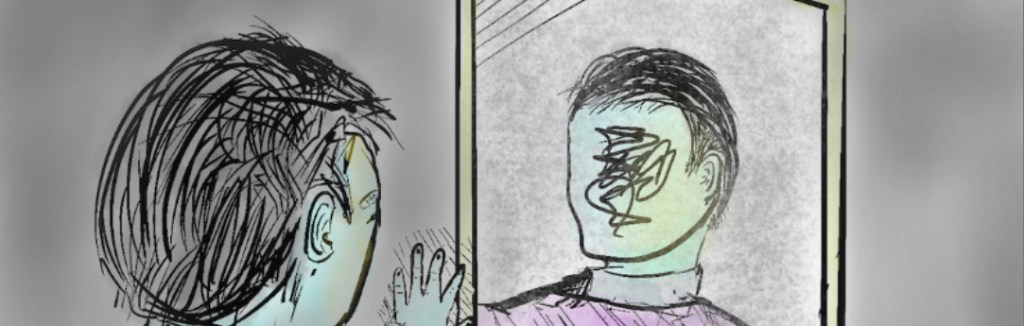
Written in our genes?
Rethinking Nature and
Nurture in Human Potential
Reading Time: 10 Minutes
Date Published: 10/11/2025
Author: Elias Mekuriaw
Artist: Elgin Tawiah
Lasting over 20 years, a landmark study on twins examined the relative influence of genetics and environment by comparing monozygotic (identical) and dizygotic (fraternal) twins. The research, led by psychologist Thomas Bouchard, involved 137 sets of twins and triplets reared apart (i.e., each set raised in different environments) who underwent an extensive medical and psychological evaluation. The findings strongly suggested that genetics played a central role in shaping individual traits; meanwhile, the influence of being reared together (i.e., each set raised in similar environments) was minimal.1 One of the most famous cases from this research was that of the “Jim twins,” Jim Lewis and Jim Springer. Although raised in separate families, they shared an extraordinary number of similarities: both named their childhood dogs Toy, both excelled in math while struggling in English, both pursued careers in security, and both married (and divorced) women named Linda before remarrying women named Betty. Each had a son named James Alan, both vacationed in Florida, only three blocks apart, and both smoked Salem cigarettes while suffering from chronic tension headaches.2

A related line of research was conducted by psychologist Nancy Segal, who studied three groups: Danish monozygotic twins reared apart, Chinese monozygotic twins reared apart, and “virtual twins” (i.e., unrelated siblings raised in the same household). Her findings showed that while intelligence levels may fluctuate over time, the trajectory of those changes is largely influenced by genetic factors.3 Segal explained, “As we get o[l]der, genetic factors become more important in fashioning our general ability. Home factors are more important when we are younger, but as we age, we select opportunities and events that align with our genetic potentials.”4
Robert Plomin, a leading behavioral geneticist, echoed this view in an interview with The Spectator: “At one time, people thought family members were similar because of environment, but it turns out that the answer—in psychopathology, personality, and cognition post-adolescence—is that it is all genetic!”5 This connects back to the broader debate surrounding the heritability of IQ, with many studies estimating that roughly 70% of variation is attributable to heredity and the remaining 30% to environment. While the precise figures remain contested, the central question persists: how much of who we are is written into our genes?

This question becomes further pervasive when certain genetic syndromes substantiate that biological constraints influence personality. For instance, Williams Syndrome, caused by the deletion of about 26 genes on chromosome 7, is linked to a striking behavioral profile.
individuals are often described as hypersociable and highly verbal, even while experiencing moderate intellectual disabilities and deficits in other cognitive skills.6 Similarly, Prader–Willi Syndrome, caused by the loss of paternal genes on chromosome 15, produces an insatiable appetite that often leads to obesity, illustrating how a single genetic alteration can profoundly affect daily behavior, appetite, and self-control.7 These syndromes underscore how genetics can impose rigid boundaries on personality and cognition in ways that environmental factors alone cannot explain.Another strong case for the influence of genes comes from studies on addiction. Researchers have identified that certain genes, such as DRD2, which affect dopamine receptors, increase the likelihood of substance dependence and addiction.8 Twin studies conducted in 1990 by Kenneth Blum consistently show that if one identical twin struggles with alcoholism or drug abuse, the other twin has a much higher chance of experiencing the same addiction, even if they were raised in completely different households.8 This suggests that our genetic wiring makes some individuals more vulnerable to addictive behaviors than others.
Another study examined a genetic variant of the DRD2 gene, D2A1, suggesting that its effects may extend to other forms of addiction, such as gambling.9

This study, involving 222 individuals with pathological gambling, suggested that the D2A1 gene played a significant role in the development of pathological gambling. As a key finding, 48 controls and 102 gamblers completed a shortened version of the Pathological Gambling Score. Among the 45 controls who scored zero (indicating little gambling pathology), 17.8% carried the D2A1 allele, whereas 52.5% of the 99 gamblers with scores of five or higher carried the allele.9
Yet, despite this powerful genetic evidence, the role of environment or nurture cannot be dismissed. Epigenetics has revealed that genes are not fixed instructions but instead can be turned on or off by environmental factors such as diet, trauma, or stress. For instance, studies on mice have shown that maternal neglect alters the expression of stress-related genes, leading to long-term behavioral and physical changes such as hyperactivity, low body weight, and even negligence towards future offspring in female mice.10 In humans, similar principles apply: a child with a genetic predisposition for anxiety may never develop it if raised in a supportive and stable environment.
Intelligence, too, is shaped by more than just DNA. While genetics may establish a baseline, environmental conditions during childhood—such as nutrition, quality of education, and access to enrichment—can significantly raise or lower IQ. This is reflected in the Flynn Effect, the steady rise in average IQ scores across generations, attributed to improved nutrition, education, and social conditions rather than any rapid genetic changes.11 Such findings emphasize that the environment can play just as critical a role in determining developmental outcomes.
Addiction is another area where nurture proves decisive. Even individuals with a strong genetic predisposition to substance abuse can overcome or avoid addiction through therapy, social support, and lifestyle changes. Cognitive-behavioral therapy (CBT),12 12-step programs,13 or even something as simple as moving away from harmful environments can reshape outcomes. In this way, while genes may increase susceptibility, they do not dictate the future.Taken together, the evidence suggests a constant interaction between nature and nurture. Our genes provide a blueprint—sometimes a strong one, as in the case of Williams Syndrome or addiction risk—but it is the environment that often determines how much of that blueprint is expressed. As Segal herself noted, “Of course, extreme environments can overwhelm genetic potentials, as I described in my 2018 book Accidental Brothers. And we can all improve our skills by working hard—genes do not set abilities in stone.”14
- Bouchard T, Lykken D, McGue M, Segal N, Tellegen A. Sources of human psychological differences: The minnesota study of twins reared apart. Science. 1990;250(4978):223-228. doi:https://doi.org/10.1126/science.2218526
- Study M. Communicating Psychological Science. Communicating Psychological Science. Published June 20, 2023. https://www.communicatingpsychologicalscience.com/blog/minnesota-study-of-twins-reared-apart-pale7
- Segal NL, Pratt-Thompson E. Developmental trends in intelligence revisited with novel kinships: Monozygotic twins reared apart v. same-age unrelated siblings reared together. Personality and individual differences. 2024;229(112751):112751-112751. doi:https://doi.org/10.1016/j.paid.2024.112751
- Dolan, Eric W. Groundbreaking Study Reveals the Impact of Genetics on IQ Scores Over Time (PsyPost, 2024).
- Sauce B, Matzel LD. The paradox of intelligence: Heritability and malleability coexist in hidden gene-environment interplay. Psychological Bulletin. 2018;144(1):26-47. doi:https://doi.org/10.1037/bul0000131
- Cleveland Clinic. Williams Syndrome (Williams-Beuren Syndrome): Causes, Symptoms & Treatment (Cleveland Clinic, Cleveland, Ohio; published approximately 8 years ago).
- Mayo Clinic Staff. Prader-Willi Syndrome – Symptoms and Causes (Mayo Clinic, Rochester, Minnesota; published approximately 9 months ago, Nov. 2024).
- Blum, K., Noble, E. P., Sheridan, P. J., et al. Allelic Association of Human Dopamine D2 Receptor Gene in Alcoholism(JAMA, 1990; 263(15): 2055–2060).
- Comings, D. E., Rosenthal, R. J., Lesieur, H. R., Rugle, L. J., Muhleman, D., Chiu, C., Dietz, G., & Gade, R. A Study of the Dopamine D2 Receptor Gene in Pathological Gambling (Pharmacogenetics, 1996 Jun; 6(3): 223–234).
- Sakai, Jill. Negligent, Attentive Mouse Mothers Show Biological Differences (University of Wisconsin–Madison News, Madison, April 9, 2008).
- Trahan, L., Stuebing, K. K., Hiscock, M. K., & Fletcher, J. M. The Flynn Effect: A Meta-analysis (Psychological Bulletin, 2014 Jun 30; 140(5): 1332–1360).
- Cognitive Behavioral Therapy (Mayo Clinic, Rochester, MN; updated February 26, 2025)
- 12 -Step Programs for Addiction Recovery (Addiction Center, United States; accessed 2025).
- Dolan, Eric W. Groundbreaking Study Reveals the Impact of Genetics on IQ Scores Over Time (PsyPost, July 10, 2024).
 Penn Grey Matters